So, once upon a time there was an ocean, and it supported different types of life. One of these life forms, in fact, one of the first to emerge out of this hotbed of biological activity was seaweed, which while it resembles modern day plants is actually a type of algae, and predates plants as we know it by thousands of years.
 |
| Do not let the name or appearance fool you! This is a nasty group of unicellular algae working together as one biological unit. |
The reason why agar is in the walls of algae is because it provides excellent structural support with flexibility. This same quality makes it valuable to chefs with molecular gastronomic intents, who must use it sparingly because it also acts as a laxative. Vegetarians use it as a beef-free alternative to gelatin, and for this reason it's increasingly used by companies as a thickener for soups, jellies, and ice cream. Did I mention it is completely non-toxic?
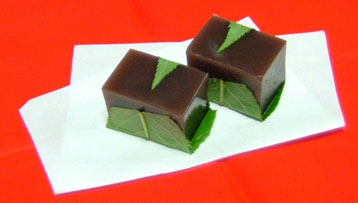 |
| Tasty, tasty seaweed. |
For us rats who reside in the darker, flourescent-lit and often horrendously smelly laboratories, agar proves of interest because of its quality as a medium. In microbiology labs, agar is mixed with variable concentrations of solvents to produce solid or semi-solid medium. Its ability to provide an oxygen gradient is invaluable to scientists growing anaerobic bacteria, and unlike vegans and vegetarians across the country, bacteria will not eat agar and instead simply set up shop upon it.
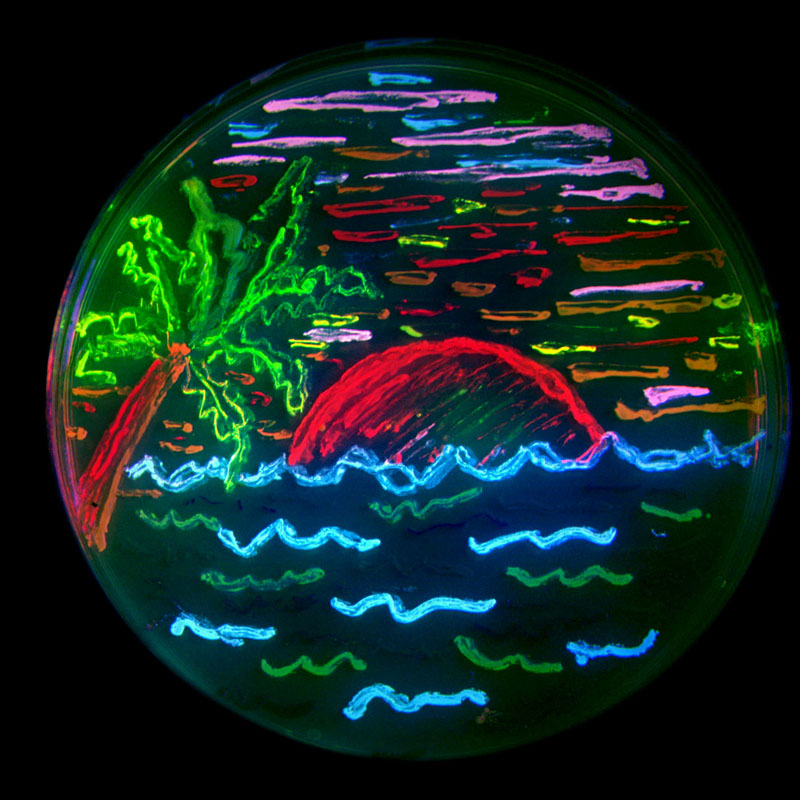 |
| An agar plate, upon which bio-luminescent bacteria apparently unanimously decided to grow in a scenic pattern. Note: there is no eating going on here. |
In molecular biology and genetics, agar is encountered in the process of gel electrophoresis. The basics of this technique are very simple. Opposite charges attract - negative attracts positive, and positive attracts negative. In gel electrophoresis, a gel medium is placed inside a buffer solution inside housing that is connected to an electrical source. One side of the housing is connected to the cathode, the other side of the housing is connected to the anode. Samples of different substances, primarily DNA, are placed inside wells in the gel and the device is turned on. Once that happens, the charged samples move to their respective "opposite" sides. The movement of these particles therefore depends on their size, shape, and charge. Bigger particles move slower, and the more charged a particle is, the faster it will move to it's oppositely charged side.
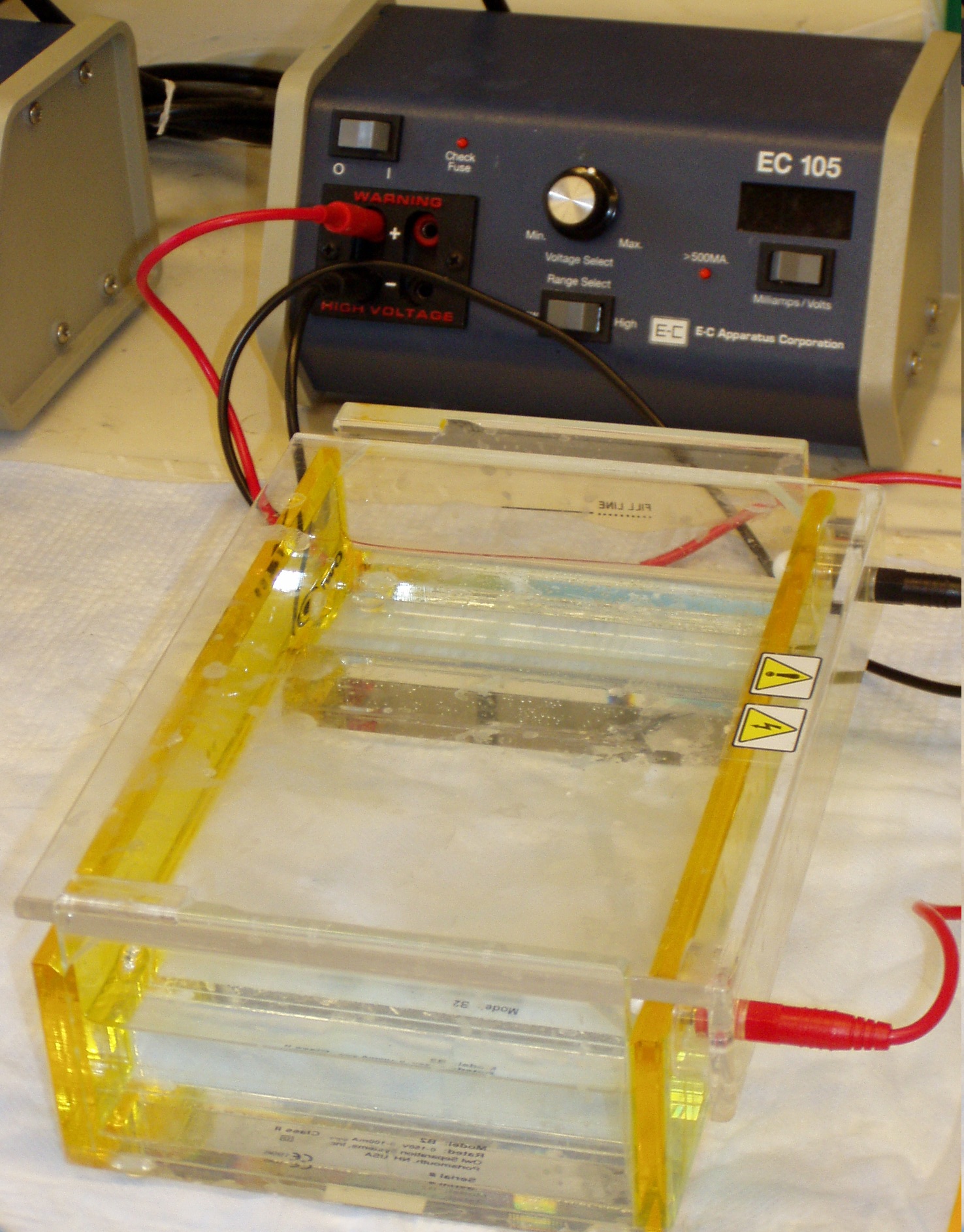 |
| Gel electrophoresis apparatus. Observe the disparity between the coolness of the name and the visual of the device. |
Agar is chosen as a gel medium because when its placed in solution, depending on its concentration it will form pores of various sizes. The particles in the samples move through these various sizes, thus by adjusting the concentration of the agar in the agarose gel medium you can select how fast the particles move and how much they become separated. Another quality of agar that makes it the molecular diagnostician's wet dream is the same one that makes it a chef's bee's knees - it's lack of toxicity. There is another gel medium used in electrophoresis, by the ugly and smart-sounding long name of polyacrylamide, which is so ridiculously toxic it kills neurons. You can automatically tell who the favorite is here.
Why is gel electrophoresis useful? Well, DNA is negatively charged. This makes gel electrophoresis a great tool for separating DNA from other components, and separating differently sized and charged particles from each other for isolation.
Yet another example of the incredible, edible seaweed!

No comments:
Post a Comment