Monday, September 19, 2011

Baby's Daddy

A paternity test. On this day, our professor told us, we were going to perform a paternity test. The simple mention brought up images of screaming mothers, custody battles and unpaid child support. It reminded me of daytime talk shows like Dr. Phil performing paternity tests on the featured guests, only revealing the results after a whole hour of relentlessly obnoxious arguing. But what is a paternity test? I always imagined blood samples being put in some high tech machine and the result being simply printed out on a long sheet of perforated computer paper - the all-knowing Daddy machine.

But being as how we were performing one in our lab, the same lab where presentations are still being done on Kodachromes, our wet preps are sealed with gaudy nail polish, and the lack of hygienic foot stools switches on the sinks, I knew it couldn't be that complicated.

The process is an extension of a gel electrophoresis technique. DNA is taken from the prospective fathers, the mother, and the child, and then mixed with restriction endonucleases, which cut the DNA at specific recognition points.

Now, DNA is unique to every single person in the world. However, the more closely related you are to a person, the more closely your DNA will resemble that other person's. Variation in DNA is based on amino acid variation, therefore an analysis of the sequence of amino acid and its similarity will yield the relatedness of two different people.

Back to those restriction endonucleases. Since they cut at specific recognition sites (specific sequences of specific amino acids), the cuts will vary depending on the DNA. DNA that closely resembles another person's DNA will have cuts that are very similar, and oftentimes the same exact cuts (multiple digestions with multiple restriction enzymes will yield more specific results). So what does this have to do with child support?

After the gel is run and the fragments allowed to seperate, ethidium bromide is applied to bind to the DNA and mark it. Then the bands of DNA can be visualized under UV light.


The bands are then compared to each other. If the prospective father contributes bands to the child that the mother does not, then that guy is the dad. Probably.

Of course, definite decisions are not made until the process has been repeated with multiple restriction endonucleases multiple times. And then, well, hopefully one of the men is the father.

Wednesday, August 31, 2011

Poop's Lessons

"A parasitologist is a quaint individual who spends all day on a stool looking at another one."

This was one of the first things that greeted us upon entering the parasitology lab, which, although since my department consists of only one floor and this lab being the only one on the floor, is the same laboratory  I have all my labs in these days, we all knew that it would be different.

Our professor introduced herself as "the Poop Queen." All fecal matter aside, there would be no Parasitology lab.

And this is the main gist of it. I grew up thinking I was so interested in parasitology, aweing and gawking at countless colorful pictures of deformed and misshapen extremities. I heard tales of the origins of the physician's staff symbol (look it up) and loved taking my pets to the vet because it meant I got to see a dog's heart-worm infected heart preserved in formalin upon his desk. I thought I loved parasitology, and when I found out I would be taking it this semester I was ecstatic. The laboratory and the lecture! How awesome!


His name is Cadaceus. Awe at him.

So when my professor greeted us with those words, I felt it must be truly in jest. Surely, a parasitologist's job involves more than just gazing at poop. But from the beginning of lab, I knew I was mistaken.

We began the lecture by discussing the proper collection and preservation techniques for "formed" and "diarrhetic" stool, and just dove deeper and deeper into the subject. Stool samples, especially fresh diarrhetic ones, must be examined quickly. Diarrhetic samples must never be allowed to cool. And did you know: oftentimes the infective form of a parasite is only in formed stool, and not present in diarrhea?   Throws off that evolutionary theory that pathogens always cause symptoms that help progress their reproduction and spread, now, doesn't it?

We then spent thirty minutes going over pictures of all of the crap that can be found in crap. Hair that suspiciously resembled worms, fibers that looked astonishingly like larva, animal, vegetable, and plant cells that just looked creepy, and of course, the ever present ubiquitous "fecal debris." All normal. And then, the abnormal. Amoebic trophozoites (the form you see when you think amoeba) and cysts, roundworm and hookworm larvae and eggs.

Formed specimens can be kept in formalin and refrigerated for up to 24 hours. The most common stool sample stain is a simple iodine wet prep. So on and so forth. And then we did it.

The samples of stool were small enough not to smell badly, but were large enough to constantly remind you what exactly they were. A caramel brown color, they consisted of about ten milliliters of liquid in yellow-lidded sample tubes. We had to place a tiny drop of iodine upon a large microscope slide, and then place an even smaller drop of stool right on top of it, then mixing it. We placed a coverslip gently over. If any of the mixture seeped outside the range of the coverslip, we had to do the procedure all over again. If it did not, we were free to use nail polish - yes, nail polish - to seal the edges of the coverslip to the microscope slide, in order to prevent the sample from drying out.

We allowed the nail polish to dry, setting up Koehler Illumination as we did so (a whole other blog post), and then checked out our "stuff."

Immediately, I was struck by the amount of crap that was in crap. Granted, we'd spent the past hour and a half discussing it, but to actually see it was an entirely different. I was assaulted by all forms and shapes of various sizes but generally of a brown color. Being by nature a microbiology nerd, I noticed first the various rod-shaped and round bacteria Brownianly floating and squirming by, and would have like to oil-immersion those buddies and check them out.

However, being a wet prep, we were expressly forbidden to use oil immersion and were limited to using the 40x objective. The reason was that before we left lab that day, we had to find some sort of parasitic remnant in our stool sample. So systemically, I looked and looked and looked.

I found a whole bunch of wormy-looking fibers, some of disturbingly bright colors, round things that were too small to be anything and contained nothing of importance, and as always and forever - fecal debris.

Finally, after thirty minutes of looking, I found a cyst. It was a harmless looking thing, perfectly round with little dark circles inside (nuclei).  Yet however friendly this guy might appear, he wasn't messing around. He was the infective form of Entamoeba coli. OK, not strictly a pathogen, but definitely a guy you didn't want floating around in your food or water. He was a valuable indicator of fecal contamination, meaning where he was hanging out, poop wasn't far from him.


Entemoeba histolytica/dispar cyst. NOT something you want floating around in your drinking water.
We'd spent a good two solid hours looking at these stool samples, and by the end of it I came to realize something. Sure, there's the obviously trite and cute lesson of "one man's trash is another man's treasure," but there's also the deeper lesson of how all-expansive life is.

Here we were, staring at life forms whose entire existence revolved around stool, something we consider nothing more than to be "dumped" and flushed away. An entire existence was going on in something we never ever take a moment to think about, unless we're sick, and then it's only in terms of its shocking volume or lack thereof.

And there are plenty of things like this, existences going on in long hidden (maybe forever hidden) worlds, microbiology being a perfect example of a once-hidden world that was revealed to contain so much with the advent of the microscope. We think that such existences are insignificant, not because they are but because we do not understand them or fail to notice them. Our existence is surely among them, a world that makes little to no impression upon other worlds around it, worlds that exist outside our sphere of influence, or far too inside to ever become noticeable.

And other worlds may interact with ours, worlds that govern our every interaction and every moment of our being but are too intrinsic and basically a part of it that we have and will continue to fail to notice them.

All this, from a stool sample.

Tuesday, August 23, 2011

Gel Electrophoresis, or the Electrical Seaweed

Today I had my first lab in the Clinical Laboratory Science program, my first professional program, and I also created my own agarose gel! It was so exciting!

So, once upon a time there was an ocean, and it supported different types of life. One of these life forms, in fact, one of the first to emerge out of this hotbed of biological activity was seaweed, which while it resembles modern day plants is actually a type of algae, and predates plants as we know it by thousands of years.

Do not let the name or appearance fool you! This is a nasty group of unicellular algae working together as one biological unit.
This seaweed, quickly becoming a source of food for many other forms of life springing up in the ocean, also possessed certain qualities which make it useful for specific groups of individuals for specific reasons. The polysaccharide walls of red algae seaweed contains something called agar, which besides being one of the hardest words to rhyme also is a polymer made up of the sugar galactose.

The reason why agar is in the walls of algae is because it provides excellent structural support with flexibility. This same quality makes it valuable to chefs with molecular gastronomic intents, who must use it sparingly because it also acts as a laxative. Vegetarians use it as a beef-free alternative to gelatin, and for this reason it's increasingly used by companies as a thickener for soups, jellies, and ice cream. Did I mention it is completely non-toxic?

Tasty, tasty seaweed.

For us rats who reside in the darker, flourescent-lit and often horrendously smelly laboratories, agar proves of interest because of its quality as a medium. In microbiology labs, agar is mixed with variable concentrations of solvents to produce solid or semi-solid medium. Its ability to provide an oxygen gradient is invaluable to scientists growing anaerobic bacteria, and unlike vegans and vegetarians across the country, bacteria will not eat agar and instead simply set up shop upon it.

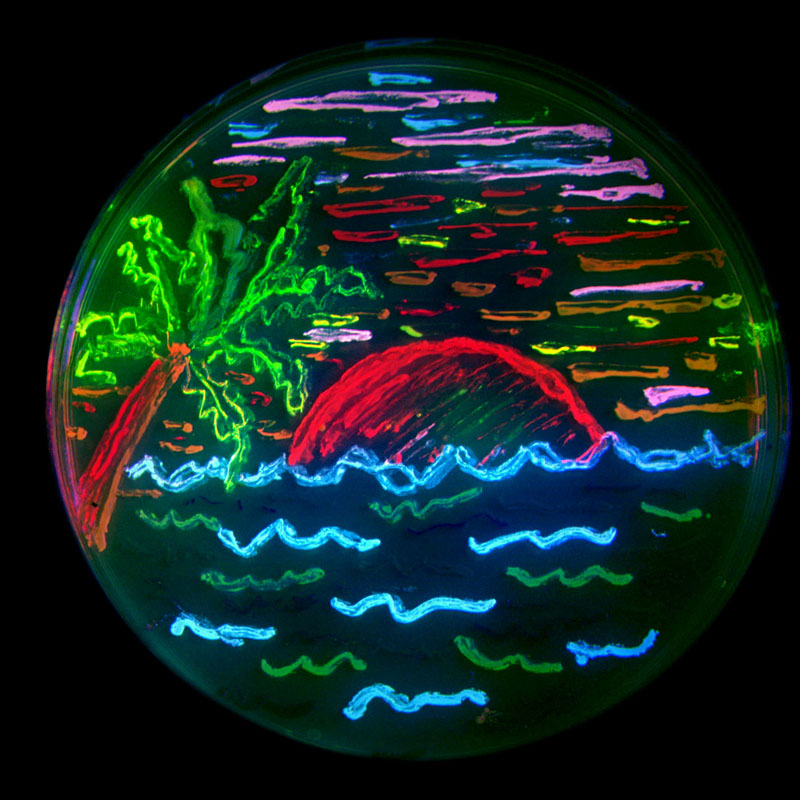
An agar plate, upon which bio-luminescent bacteria apparently unanimously decided to grow in a scenic pattern. Note: there is no eating going on here.

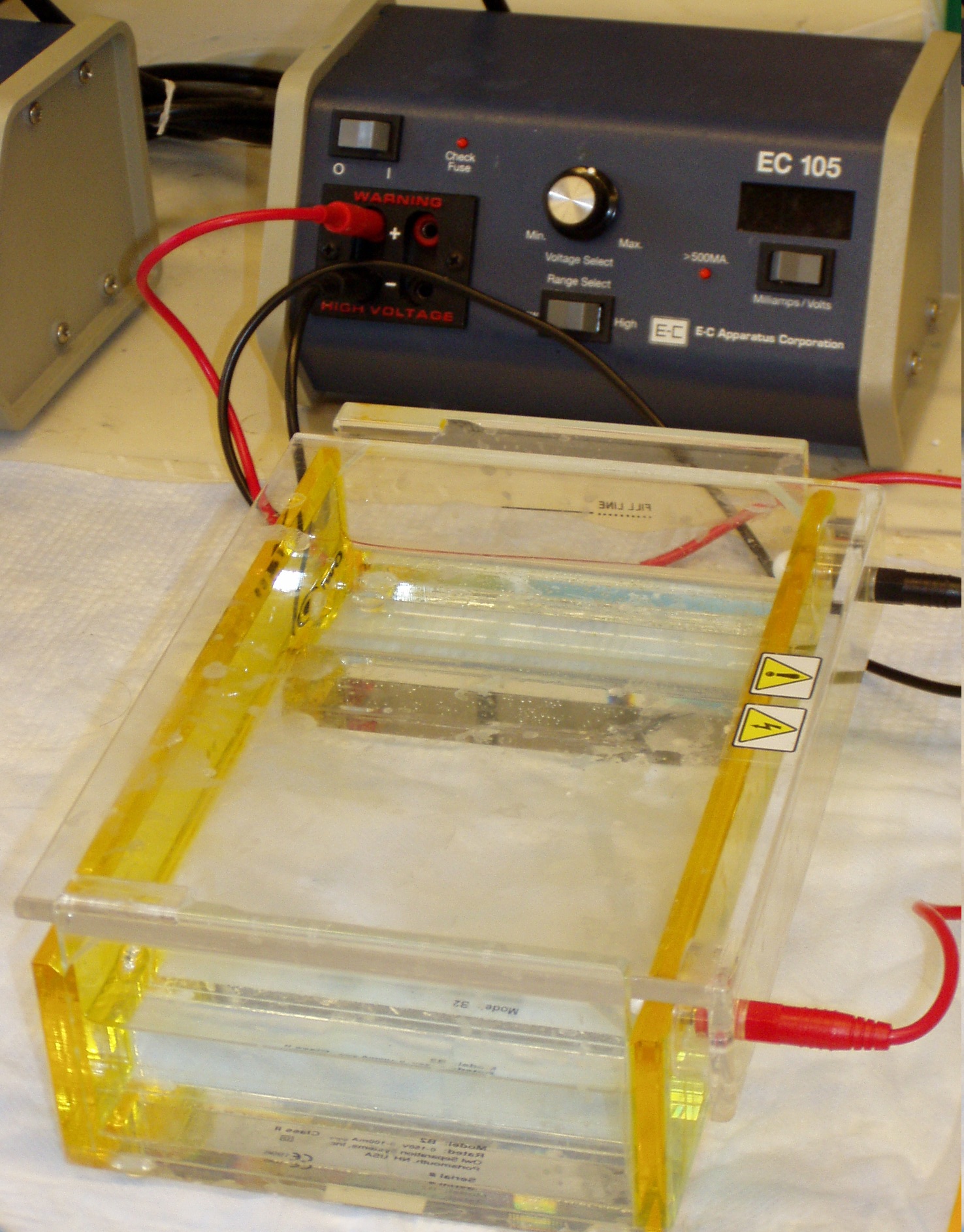
In molecular biology and genetics, agar is encountered in the process of gel electrophoresis. The basics of this technique are very simple. Opposite charges attract - negative attracts positive, and positive attracts negative. In gel electrophoresis, a gel medium is placed inside a buffer solution inside housing that is connected to an electrical source. One side of the housing is connected to the cathode, the other side of the housing is connected to the anode. Samples of different substances, primarily DNA, are placed inside wells in the gel and the device is turned on. Once that happens, the charged samples move to their respective "opposite" sides. The movement of these particles therefore depends on their size, shape, and charge. Bigger particles move slower, and the more charged a particle is, the faster it will move to it's oppositely charged side.

Gel electrophoresis apparatus. Observe the disparity between the coolness of the name and the visual of the device.

Agar is chosen as a gel medium because when its placed in solution, depending on its concentration it will form pores of various sizes. The particles in the samples move through these various sizes, thus by adjusting the concentration of the agar in the agarose gel medium you can select how fast the particles move and how much they become separated. Another quality of agar that makes it the molecular diagnostician's wet dream is the same one that makes it a chef's bee's knees - it's lack of toxicity. There is another gel medium used in electrophoresis, by the ugly and smart-sounding long name of polyacrylamide, which is so ridiculously toxic it kills neurons. You can automatically tell who the favorite is here.

Why is gel electrophoresis useful? Well, DNA is negatively charged. This makes gel electrophoresis a great tool for separating DNA from other components, and separating differently sized and charged particles from each other for isolation.

Yet another example of the incredible, edible seaweed!

Tuesday, March 8, 2011

Some Horrors of the Microbiology Lab

You may have heard the stories - rumors of the awful smell, the evil microscope, the slippery slides.
Or perhaps you've been spared such morbid tales. Either way, the truth about microbiology lab is stranger than any fiction.

Upon entering this lab, one is assaulted with a barrage of rules, restrictions, and protocols - as with any labs. But these are very different. Things like not bringing your cell phone with you beyond the lab benches or else it will be autoclaved, washing your hands every single time you do something, and handling spills with intensity. You begin to realize you are surrounded by dangerous things, and then it starts - the paranoia.

One of your first lab experiments is inevitably swabbing random items and growing a culture (culture being a fancy word for growing microorganisms in an extra-hospitable environment). This is to teach you the ubiquity of microorganisms - how they can be found anywhere.

That's one powerful magnifying glass.

And this is where it begins. As soon as you remove your plate from the incubator and find it engulfed in unidentifiable growth, you realize you have been living in an unseen world, surrounded by creatures. They have been crawling all over you and your food for years and years, making you sick, making you fart, giving yogurt that tart flavor and weird cheeses their toe jam smell. They played a part in the making of your beer, the rising of your bread - in short microbes are behind everything that sucks and everything that is awesome that has ever happened in the entire world.

And you know are aware of their presence. Not only that, but how easily they grow and how dangerous they possibly can be. Like E. coli, or Salmonella sonnei, nasty bugs that can take you down in hours, or days, bugs that can kill.

This guy will chew you up and spit you out (if he could chew and spit)
 You will never look at a bathroom - or a kitchen - the same way again, and the smell of agar will linger in your nostrils.

Tuesday, February 8, 2011

Bad Day to Be My Left Hand

Today was one of those days when things that can go wrong, will. In microbiology lab, our assignment was inoculating a wide assortment of bacteria to different types of selective and differential media. This involved several different types of bacteria, including S. aureus, S. typhimucium, E. coli, E. faecalis, and S. sonnei. It also involved several different types of media, mostly plates like MacConkey's agar.

I had done good time on the inoculation of plates and was on the last organism of the last plate when, holding the tube of cultured bacteria in my left hand, the inoculation loop in my right, and using my left hand to open the lid of the plate that was to be inoculated, the culture spilled EVERYWHERE...all over my hand, all over the lid of the plate, and all over the lab bench.

As annoyed and alarmed as I was, I knew the procedure for handling such a spill - I also knew that the bacteria could not get into my skin and infect me unless I had a cut or touched my face or another body opening with that contaminated hand. I proceded with my non-contaminated hand to remove everything that I could that was uncontaminated from the area so that clean up would be easier. All I asked of my lab partner was that she get a paper towel wet with Wescadyne (an iodine colored disinfectant we use for lab) to grab the culture out of my hand, as some of the culture had spilled on the tube and I didn't want to contaminate my right hand. She did that, but she also freaked out and ran to the T.A in extreme alarm, as I calmly sprayed Wescadyne on the spill and then washed my hands with soap and ethanol (strong decontaminant...obviously). My T.A then told us to do exactly what I was already in the middle of doing, and my partner decided that things were ok and it was no longer worth freaking out about.

I washed my hands thoroughly three times, then continued with the lab extrememly carefully. I was not going to make THAT mistake again.

Then, alas, another lab on the same day - general chemistry 1, without a doubt the most tedious lab I have ever had the misfortune of taking. The procedure was simple. Heat up magnesium in a crucible (i.e, a porcelain pot) until it combusted, and reacting with oxygen produced MgO (magnesium oxide). Weigh it both before and after heating. Then heat two hydrate salts (hydrate = contain water) until the water evaporates and record the changes in mass, color, etc. Very very simple.

Unfortunately, simple things get complicated fast when the wrong tools are used. Our crucible was a tiny little thumbpot, and our tongs (to hold it hot) were large and grasped poorly. My lab partner broke our crucible within the first fifteen minutes of our beginning that experiment, and we got a new one. This new one, amazingly, was actually smaller than the old, and even harder to carry with tongs (if not impossible). My partner asked me to use the tongs to remove the crucible after heating this time, and I obliged.

I grabbed the hot crucible with the tongs, and then it lost its grip and slipped up to the lid. The lid, being far too large for the crucible, rested on it loosely and thus was easily disturbed by the tongs. It fell off the crucible and I caught it with the tongs, but it was still in an unstable position.

It fell, and instinctively I reached out my left hand to catch it. Burning my hand, a reflex arc worthy of physiology went on and caused me to drop the extremely hot lid, which proceeded to land on the lab bench and break in at least three pieces.

I didn't realize how badly burned I was at first; I saw two white markings where I had contacted the lid, but I figured those were powder precipitates from the heat and would easily come off, and I waited a few minutes before washing my hands under cool water.

The precipitate was actually the upper layer of my skin seperating from the lower layer in severe second degree burn, and after the adrenaline wore off the pain began.

So, the moral of the story is, if one day you are reincarnated or otherwise somehow given the option to inhabit or be someone's body part, do not choose the left hand of a right handed person. It's a rather tough existence.

Monday, January 17, 2011

On the Subject of Glassware

Upon entering the lab, one thing you must quickly learn, whether you be a student, T.A, or something else, is how to work with glassware. Inevitably, things will be broken. But that's ok, because either your lab fee is included in your tuition and fees (which you hopefully have already paid) and you will get a moment of silence in which the class stares at you in vicarious fear (granted they hear it) and a dirty look from your supervisor (at worst), or you can hide the evidence and pretend nothing happened (not advisable, but I'll leave the option to you).

Glassware is like a fickle child; some days, you can be careless and throw it around a bit and nothing at all happens, while other times, you handle it with care and it just breaks all over you...perhaps that metaphor is not entirely fitting. At any rate, it can and will betray you. Not a question of if, but of when.

I've had my share of accidents and struggles with the heated silicon solid. My first, in the lab, was when we were starting a series of measurement experiments in 9th grade and there was a graduated cylinder sitting on the edge of a lab bench (FYI: any table located in the lab with a seat nearby is referred to as a lab bench. I have no idea why). I was not paying attention and knocked it over with my elbow. Our teacher blew a gasket, yelling at how we had no appreciation for all the things she did for us and that we didn't deserve to do the experiment in the first place and that we couldn't even behave for one...Anyway, the graduated cylinder shattered into pieces once it hit the tiled floor, and I pretended I didn't know what was going on.

I shattered two pieces of glassware in organic chemistry lab. The first was a large beaker. I had it in the sink, washing it carefully when the water and the soap made it slip just plain out of my hand. I told our TA, and he nonchalantly handed me a small broom with a dustpan. I cleaned it up, and disposed of it properly. The next time, incidentally, also occurred while I was cleaning.

The thing about organic lab is that like dissolves like - nonpolar solvents dissolve nonpolar solutes, while polar solvents dissolve polar solutes. Most of what you deal with in organic chemistry contains carbon in it - all of it should - and the molecules primarily consist of carbon to hydrogen bonds and carbon to carbon bonds. The thing about carbon-carbon and carbon-hydrogen bonds is that they are not polar; that is, the two elements don't differ enough in electronegativity (in the case of hydrogen-carbon) or don't differ at all (in the case of carbon-carbon). So most organic chemicals will not rinse off with simply soap and water - you need a nonpolar solvent like acetone (aka nail polish remover) to fully get rid of the chemicals.

Acetone is a very volatile chemical - it evaporates very quickly and becomes a vapor. That would all be fine and dandy, except that it and its vapors are extremely flammable and also can make people ill. So when you're dealing with acetone in a chemistry lab, it's usually under a fume hood (which sucks away all the fumes and keeps them from escaping into the room, while also protecting you from them). We have a fume hood in which all of our cleaning chemicals are housed, along with brushes and chemical disposal containers.

I was in this fume hood, foolishly holding three pieces of glassware in one hand over the chemical disposal bin while spraying that glassware with acetone held in a squirt bottle in my other hand. A roundbottom flask slipped from my hand and fell onto a 25 ml Erlenmeyer flask that was resting in the hood. The roundbottom held up; the Erlenmeyer did not. I cleaned up the mess with a dust pan and broom, and again, disposed of them properly.

I lost a good deal of glass capillary tubes in organic as well. These tiny things are used to obtain trace bits of chemicals in order to obtain a melting temperature with the melting temperature apparatus. I broke one inside the apparatus, though with the help of scotch tape, another capillary tube, and McGuyver-like quick thinking, I was able to remove it without damaging the equipment.

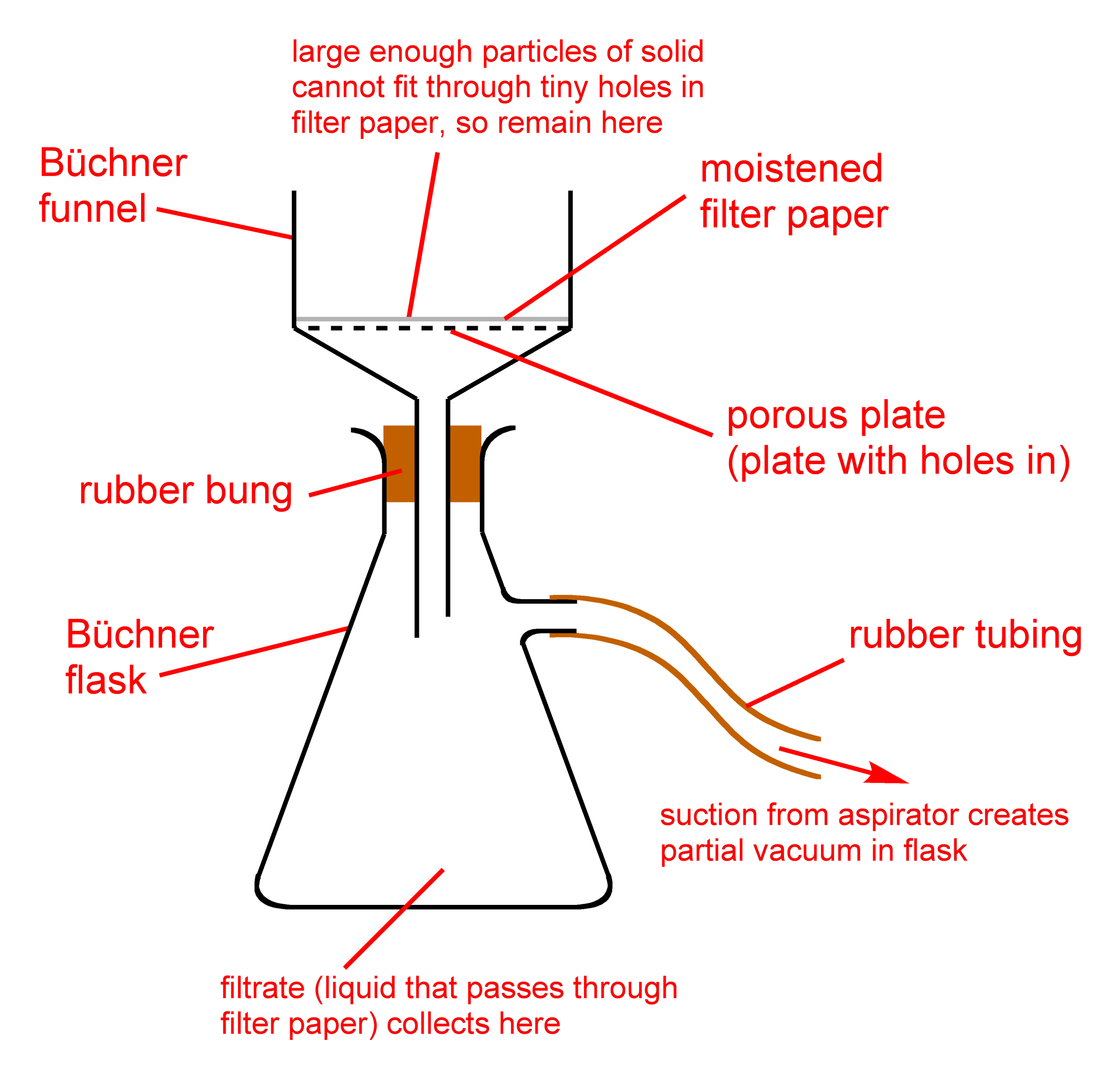
My worst experience with glassware occurred in organic chemistry lab also. We were extracting chemicals from a solution that we had already purified painstakingly through a distillation and a crystallization; now we were simply running the crystals through a filter paper-lined funnel inserted into a suction flask, which was then connected to a vacuum - the object of this was to remove all of the liquid from the crystals, so that drying the crystals, which would be the next step, wouldn't take days.

Vacuum filtration set up. Observe the location of the rubber stopper.

I inserted my vacuum tube (we had one vacuum tube, one water tube, and one blowing tube at each hood) into the suction filtration flask, and had my crystals all set up, and turned on the air. Now, there is a rubber stopper that needs to be inserted into the mouth of the suction flask in order to properly place in the funnel. I had struggled finding one that fit, the one that did fit the closest was now inserted. Well, shortly after turning on the suction, this rubber stopper began slipping into the flask.

As fast as I tried to turn off the suction, and as hard as I tried to get it out, it had happened - the rubber stopper had gotten stuck deep inside the flask, too far below the neck to reach with anything, yet not far deep enough to actually be rolling around lose. I tried using a little metal chemical scooper to get it out to no avail. Finally, in hopelessness, I told the TA, who seemed impressed with my feat, but took no time telling me brusquely to get the results from someone else - there was no yield for me to measure, so the entire experiment had failed.

Things I learned the hard way with glassware:
1. Be very very careful, especially when cleaning! Clean one piece of glassware at a time, it doesn't matter how much time you think you'll save by doing it another way. Better to take your time than make another mess you'll have to clean up anyway.
2.  Be gentle but firm with glassware. Small items like capillary tubes break very easily, but at the same time, experiments call for you to have absolute control of your glassware at all times. Find that balance and stick to it.
3. When glassware can fall and break, it will fall and break. Keep glassware away from the edges of tables, lab benches, sinks, etc., and especially with wet glassware, if a piece is prone to rolling keep it on a wire mesh or a paper towel or something similar.
4. Most glass cannot stand quick changes in temperature. Transferring a hot glass to a cold lab bench will easily shatter it. This applies to thermometers too, and it's not a pleasant sight - that red stuff looks a lot like blood, and makes you feel like a murderer.
5. Finally, breaking glass isn't the end of the world - but depending on the lab you work in, it could be the end of your career if you don't notify your supervisor immediately. Clean it up as instructed and dispose of it properly and no one will get fired - uhm - hurt.

Thursday, January 13, 2011

A Brief History

Hello, I have been a lab rat for over four years now.

It started when I was a kid of about seven and my aunt gave me a microscope. I have always been interested in science, especially the science of life, and my aunt fostered that interest and always supported it. I don't remember much about my first microscope, except that I didn't know a good deal about how to use it and I ended up breaking at least three or four slides.

Flash to about seven years later, and I had my first true lab experiences in 8th grade science. That was a mixed science class, and the experiments were all very simple - dissecting a frog, taking apart an owl pellet, learning how to use a microscope. I knew I was hooked.

In high school, I had the fortune of being part of the entering class that enjoyed an entirely new school with - yup - brand new labs. All my science courses had laboratory portions, as rare as some might be. In physics, I shot off an air-pumped rocket, in forensics, I analyzed fingerprints, in biology, I traced through the cell cycle, and my favorite, anatomy, we dissected pigs, sheep brains, and minks.

This had been coming for as long as I remember; college had never been a question for me, nor had I ever been in doubt about what I wanted to do - I wanted to major in Biology, and I wanted to become a doctor.

After actually getting to college, I changed my major to a slightly different degree plan, Clinical Laboratory Science - one where I'd take pretty much all the same support classes as a biology major, except instead of a bunch of upper division biology courses during my last two years, I'd be taking intensive laboratory-oriented courses at the local medical professions university (which also houses a medical school!) which would prepare me to sit for the Clinical Lab Scientist licensing exam; once completed, I would become a Clinical Laboratory Technologist/Scientist.

This also ensured that I would be a lab rat, if not for life, for the majority of it.

Me, in my other hat.

Entering the Lab

Today I woke up with a terrible pain in my back. What's more, a headache. I can stand a backache. But both a headache and a backache? Not so much, especially since this was my first day in microbiology lab.

Now, I've had experience with labs. I had the misfortune of taking genetics lab last semester, one in which we had to breed several strands of Drosophila melanogaster and hope to God the results corresponding to what good ole Hardy Weinberg said that they should be. We stored the buggers in about seven inch long plastic tubes, with bright sickly blue media, a toothpick, and yeast, and all plugged up with a Styrofoam stopper (I wonder how long it's going to take for all those things to decompose). At any rate, we ran out of them midway during the semester and so had to use wax paper, which didn't adhere or ventilate properly; we had to attach the pieces with rubber bands and poke perfectly sized holes in them with a toothpick (too big = escaped flies, too little = dead ones). On top of that, one entire fly tube was supposed to be in the 37 C incubator - and what inevitably happened to them was that we all waited until the end of the semester to count them and they turned into crispy critters - impossible to count. As you can probably tell by now, there was a good deal of guesstimation that went on in that lab.

Not like that was very different from my other labs. I also took physics lab, placed in a group with one person who knew what they were doing but got too irritated to bother, another person who was stoned full time and never had any idea what was going on, and one last person who was too shy to say anything at all. We ended up always being the last group finished, despite my constant efforts to keep everything together. The results would often be very different from what was expected, and so there was a lot of "fudging" of numbers - one critical skill any scientist should possess.

My general chemistry lab was the same deal, roughly. Mixing chemicals, hoping your results were at least somehow similar to what was expected. I don't remember that lab being particularly strenuous, although titrations will eventually make you want to break something.

In the end, a lot of these labs were left to luck - what's supposed to happen versus what actually happens isn't always a difference of how good you are at what you do or how closely you adhere to instructions. My experience as a lab rat - colloquially used as another term for a person who is eternally in a laboratory - has not only taught me how important luck is in the lab, but also how big of a role it plays in life.

So, if you will kindly join me, let us enter the lab and the experiences it entails.